|
Diabetes is a multifaceted disease. With the term “diabetes” we point to a number of different diseases that have in common just the hyperglycemia.
| The table that follows describes the most common types of diabetes: |
 |
|
 |
Typ 1 diabets mellitus |
|
Type 2 diabets mellitus |
|
LADA (NIRAD) |
|
Gestational diabetes |
|
Secondary diabetes |
|
|
What is the difference?
The Type 1 diabetes is most frequent, but not exclusively, among the youth, and leads to the total or subtotal destruction of the pancreatic beta cells (the insulin-producing cells). Often those with type 1 diabetes have antibodies against the beta cells or the subcellular structures inside the cells, and this is a sign of the autoimmune origin of the disease. There are however some cases with no antibodies, and this is the basis for the classification into “autoimmune” and “non-autoimmune” forms
The clinical characteristic of this form is the absolute need for insulin to survive, at least after an initial period in which insulin may not be necessary (the so called “Honeymoon period”)
Diabets type 2 is much more frequent and is on a continuous increase, expected to douvle by year 2025. The subjects are usually fat or overweight, and characteristically they do not need insulin to survive, although some of these persons need insulin to live well.
At the basis of type 2 diabetes there are 2 defects, insulin deficiency (not absence like in type 1) plus a reduced response by the organism.
So we can use an easy rule to remember that type 1 diabetes is substantially dependent on 1 problem (absent insulin production) while type 2 has 2 defects (reduced insuli production + insulin resistance). To understand this concept better we can think of 2 persons in a room, one speaking and the other not hearing. The cause of this may be that one is speaking in a too low tone, the other has a defective hearing capacity or both. Of course one of the problems may be prevalent, and this also happens in type 2 diabetes that may be classified into 2 subtypes, with prevailing insulin deficiency and with prevailing insulin resistance
It is important however to remember that the blood glucose is mantained within strict levels even in the non diabetic subject by an equilibrium between 2 opposing forces, insulin secretion and insulin resistance
Il L.A.D.A. (Latent Autoimmune Diabetes in the Adult) o N.I.R.A.D. (Non Insulin Requiring Autoimmune Diabetes) is a characteristic form of type 1 diabetes in which the destruction of the beta cells (the insulin producing cells of the pancreas) is particularly slow.
The following figure shows the typical profile of beta cell destruction in the L.A.D.A.
subject.
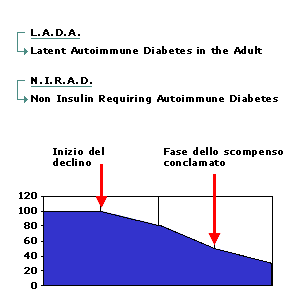
this figure represents the decline in the number of beta cells during a long time span, usually of years. If a modest increase in blood glucose is discovered in a subject who still retains a consistent percentage of his original number of beta cells (that is to say in any point between the 2 red arrows of this example) the diagnosis of type 1 versus type 2 diabetes may be very difficult, and if present in this case the markers of an autoimmune process (the autoantibodies against the beta cells and their subfractions which we discussed before) may be very useful.
Other kinds of diabetes are the gestational diabetes (appearing during pregnancy), and the so called secondary diabetes, caused by other diseases, such as hyperethyroidism, hemocromatosis and so on, and some rare cases known as M.O.D.Y (Maturity Onset Diabetes in the Young) which I will not deal with here.
|